Identity & access
Centralized authentication (SAML 2.0, SSO), role-based access control via Spatie Permission, multi-factor authentication, and session governance across all platforms.
Architecture
Verisolutions structures platforms in explicit layers with per-customer isolation, controlled deployment models, and governance boundaries designed for regulated industries.
Layered model
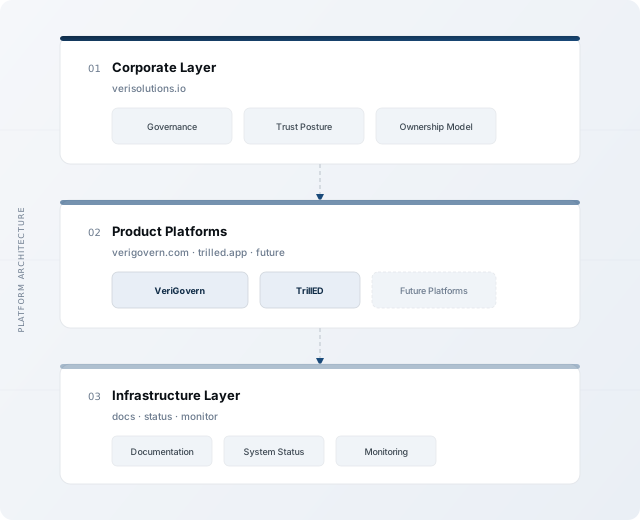
verisolutions.io
Defines strategic direction, trust posture, and enterprise ownership standards. Establishes the governance rules that all products must follow.
verigovern.com · trilled.app
Domain-specific products with independent release cycles, data models, and capability boundaries. Products inherit governance from the corporate layer but deploy independently.
docs · status · monitor
Shared operational services including documentation, system status, monitoring, and health endpoints. Consumed by all products but owned centrally.
Isolation model
Every tenant operates within a completely isolated environment. There are no shared databases, no co-mingled storage, and no cross-tenant access paths.
Each customer instance runs on isolated compute resources. No shared application processes between tenants.
Separate database instances per tenant. No shared tables, no co-mingled storage, no cross-tenant query paths.
Object storage (S3-compatible) with tenant-specific paths and access controls. Evidence files are encrypted at rest with AES-256.
Per-tenant authentication context with independent SAML provider configuration, role definitions, and session management.
Deployment models
All deployment models run identical application code. Only the infrastructure context changes — there is no separate enterprise version.
| Aspect | Managed Cloud | Dedicated Instance | IP Licensing |
|---|---|---|---|
| Infrastructure | Verisolutions-managed infrastructure | Dedicated server per customer | Customer-managed infrastructure |
| SLA | 99.9% uptime SLA | Enterprise SLA | Customer-managed |
| Updates | Automatic, managed schedule | Customer-approved windows | Customer-managed |
| Onboarding | Days | 1–2 weeks | Custom |
| Best for | Standard compliance requirements | Elevated compliance or data residency | Regulatory mandate for on-premise |
Control plane
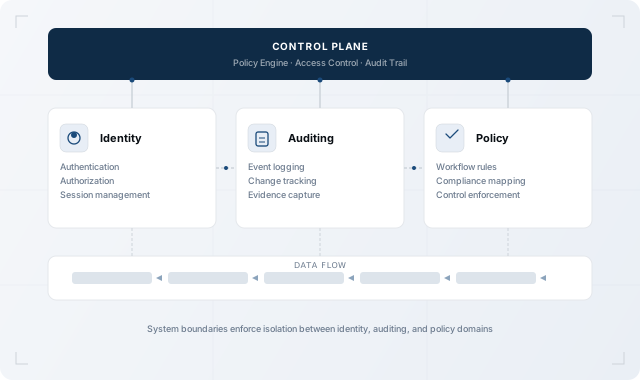
Centralized authentication (SAML 2.0, SSO), role-based access control via Spatie Permission, multi-factor authentication, and session governance across all platforms.
Immutable event logging with user identity, timestamp, and context. Change tracking and evidence capture designed to meet evidentiary standards for regulatory compliance.
Multi-step approval workflows with role-based routing, escalation, and delegation. Visual workflow design via Workflow Studio. Module-based licensing enforcement at the route level.
Principles
Every service, platform, and data domain has clearly defined ownership and integration contracts. When an auditor asks "who owns this data?", the answer is immediate.
Products release on their own cadence without requiring cross-platform coordination. A change to one product cannot break another.
Identity, audit logging, and compliance controls are inherited from the corporate layer — maintained once, consumed everywhere.
Health endpoints, status pages, documentation, and infrastructure monitoring are first-class operational concerns — not afterthoughts.
Operational commitments
Operational maturity is not a policy document — it is a system property. These commitments define how issues are escalated, how updates reach production, and what service levels are guaranteed.
All changes pass automated test suites and code review before entering the release pipeline. No direct-to-production deployments.
Updates are deployed to a staging environment that mirrors production. Regression testing and smoke tests are executed before promotion.
Managed Cloud instances receive updates on a managed schedule. Dedicated Instance customers approve update windows in advance.
Health checks, monitoring alerts, and automated smoke tests confirm system stability after every deployment. Rollback procedures are tested and documented.
99.9% availability SLA for Managed Cloud. Dedicated Instance SLAs are negotiated per contract. Maintenance windows are scheduled and communicated in advance.
Critical incidents: acknowledgment within 1 hour. Standard support: response within 1 business day. Engineering escalations: triaged within 4 hours.
Status page updates for service-affecting events. Direct notification to affected customers for security incidents. Post-incident reports for severity 1 and 2 events.
Technical discussions and architecture deep-dives available for enterprise partners.