Compute isolation
Each customer instance runs on isolated compute resources. No shared application processes between tenants.
Security
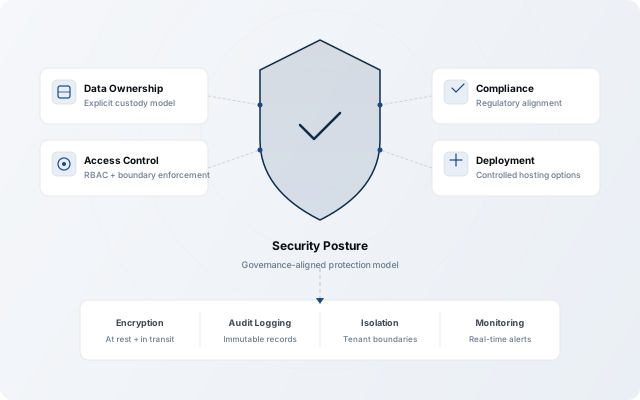
Explicit data ownership, per-tenant isolation, and governance controls designed for institutions where security posture is evaluated as infrastructure — not marketing.
Data ownership model
Data ownership is not assumed — it is defined by explicit boundaries at every layer of the platform.
Customer data ownership is contractual and technically enforced. Data never leaves the tenant boundary without explicit, auditable authorization.
Each tenant operates on isolated database instances and storage paths. There are no shared tables, no multi-tenant query paths, and no cross-tenant data access.
Data export capabilities are built into every product. Customers can extract their complete dataset at any time in standard formats.
Access segmentation
Enterprise single sign-on with multiple identity provider support. Per-provider configuration for Entity ID, SSO URL, SLO URL, X.509 certificate, and attribute mapping.
Granular permissions scoped per module and action type (view, create, edit, delete, approve, export, manage). Custom roles with specific permission sets. Enforced via Spatie Permission.
TOTP-based 2FA compatible with Google Authenticator and Authy. Mandatory or optional enforcement. Admin controls for reset, exemption, and organization-wide policy.
Database or Redis-backed sessions with individual revocation. View active sessions, terminate other devices, and enforce session timeout policies.
Infrastructure isolation
Every tenant operates within a completely isolated environment. Isolation is enforced at compute, network, storage, and identity layers.
Each customer instance runs on isolated compute resources. No shared application processes between tenants.
IP whitelisting restricts platform access to approved networks. API rate limiting enforced at 60 requests/minute for authenticated endpoints.
AES-256 encryption for stored data. Backup files encrypted with AES-256-GCM before storage. API tokens stored as SHA-256 hashes.
TLS 1.2+ with AES-256-GCM for all data in transit. Secure, HttpOnly, SameSite cookies for session management.
Compliance philosophy
Compliance is a property of the system — not a separate workstream. Audit trails, evidence lifecycle, and regulatory alignment are built into the platform layer.
Immutable, append-only event logging with user identity, timestamp, action type, entity reference, and severity classification. Records cannot be modified or deleted.
Complete chain of custody for all evidence: upload with hash verification, access logging, version history with original preservation, and controlled deletion with retention enforcement.
Platform controls designed to support IIA Standards, SOX Section 404, Basel Committee requirements, GDPR, CCPA, and ISO 27001 alignment.
Security documentation, architecture reviews, and compliance evidence packages available for enterprise procurement and third-party risk assessment processes.
Deployment governance
Security patches applied within SLA windows. Dedicated Instance customers approve update schedules.
Configurable retention and disaster recovery. Manual backup creation, download, and deletion available to administrators.
Health check endpoints (/health/ping, /health/status, /health/ready, /health/live) for load balancer and orchestrator integration.
Documented procedures for security incident detection, containment, root cause analysis, and stakeholder communication.
Security documentation and architecture reviews available for enterprise procurement.